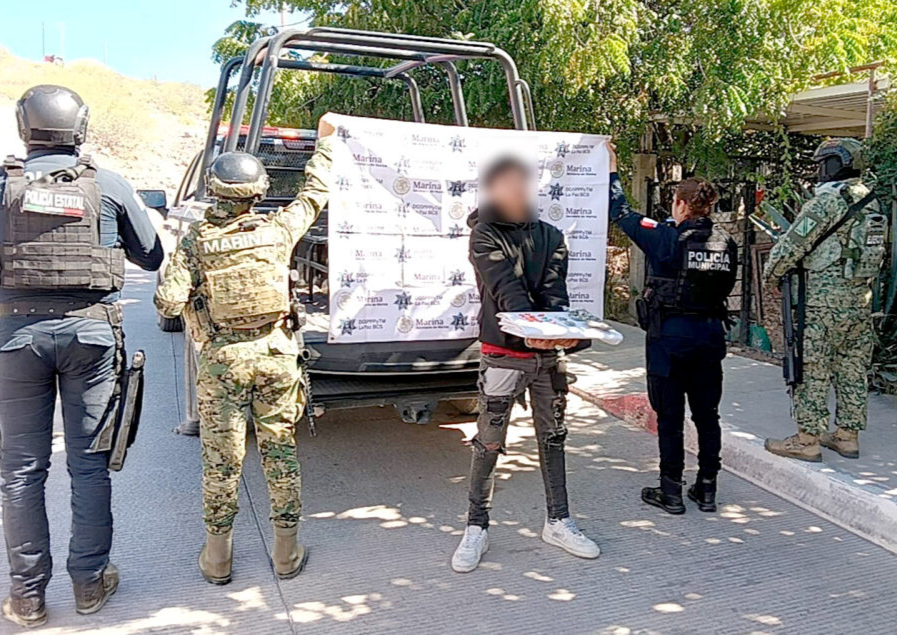

On the afternoon and evening of June 8, two alleged street-level drug dealers were abducted in the municipality of La Paz.
Guillermo Alcántar, known as “El Gramo,” 36, and Aldo Gabriel González, 44, were beaten and abandoned at kilometer 20 of the La Paz–Los Planes highway. Aldo suffered multiple injuries to his body, face, and back, requiring hospitalization at Salvatierra Hospital under yellow-code status, while El Gramo sustained injuries to his hands, back, and sides.
According to the first responder’s report, Guillermo was deprived of his liberty around 5:00 p.m. on Viento Coromuel and Avenida del Valle streets in the Valle del Mezquite subdivision. However, his residence is located on Viento de Verano Street.
The following day, the High-Impact Crimes Unit (SADAI) of the State Attorney General’s Office (PGJE) conducted a search warrant operation at the home of the alleged kidnapping victim. According to officials, they arrived at the residence on Viento de Verano Street and called out toward the interior of the home without receiving a response. As a result, they executed a search authorized by a Control Judge of the Accusatory Criminal Justice System in La Paz.
“They were taken and lined up, and afterward the product was removed from them. They are pushing Los Chapos out of Baja California Sur, and this will have repercussions in the form of violence throughout the state. The first confrontation that occurred at the end of May and beginning of June was only the break. We will have to wait for the response from this powerful group based in San José del Cabo. They have economic power, weapons, and personnel, as demonstrated by recent seizures,” explained a source from the State Security Roundtable.
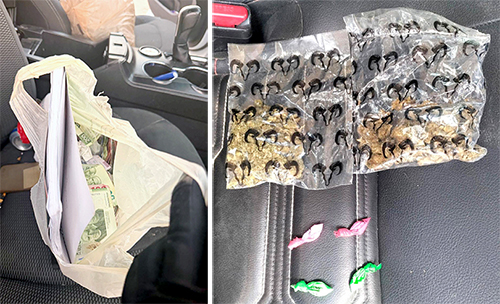
During the search, authorities seized 260 grams of marijuana, equivalent to 520 doses, and 14 grams of methamphetamine, equivalent to 350 doses. The packaging displayed holograms featuring the skull of a bighorn sheep and what appeared to be an eagle enclosed in a circle.
Another Operation in Ciudad Constitución
In Ciudad Constitución, municipality of Comondú, authorities carried out another operation on Luis Echeverría Álvarez Boulevard and Felipe Ángeles Street. Members of the Navy seized drugs allegedly intended for street-level distribution at the restaurant-bar “La Lotería.” The packaging bore the same bighorn sheep skull logo.
“Regarding other organized crime connections, particularly in Los Cabos, there is indeed a well-identified faction of the Sinaloa Cartel primarily involved in drug dealing and illegal nightlife businesses. We have identified them and arrests have been made,” stated Omar García Harfuch, Secretary of Security and Citizen Protection of the Federal Government.
According to the State Security Roundtable source, San José del Cabo has served as the economic and strategic base for Los Chapos to maintain control of territory extending as far as Guerrero Negro. From Los Cabos, they operated their command center to confront the Mayiza faction, which threatened to enter Baja California Sur from the north in October 2024.
“Today we have support from additional military personnel, the National Guard, and the Navy, allowing us to maintain operational bases in both Cabo San Lucas and San José del Cabo. This enables us to track individuals who may seek to harm the community. We have a significant deployment in Los Cabos. Most importantly, the information provided to us allows preventive actions,” confirmed Saúl González Núñez, Secretary General of the Government of Baja California Sur.
The Return of ‘00’ to Baja California Sur
The new conflict that began in late May in southern Baja California Sur, specifically in Santa Anita, San José del Cabo, has marked a turning point in the state’s criminal landscape. The Chapitos faction has weakened, and a campaign to remove its influence from the region has begun.
However, there has been a response.
“For anyone who thinks they have already won the territory, this is only beginning, MF and 00…”
This was part of a narco-message left in Guaymitas, San José del Cabo, on June 8.
For René Bastidas Mercado, known as “00,” an alleged territorial leader in Baja California Sur and parts of Sinaloa, the fight to recover his territory is not new. Organized crime specialists and members of the State Security Roundtable describe him as a strategist with a significant operational structure capable of confronting the sons of Joaquín “El Chapo” Guzmán.
According to security sources, Baja California Sur has developed a unique criminal dynamic, and indications suggest that René “00” intends to recover every space he relinquished while fighting conflicts in Sinaloa.
A de facto alliance has reportedly emerged within the Sinaloa Cartel involving Double Zero (00), MF, and Los Cabrera. Military intelligence sources claim that recordings of confrontations indicate ceasefires in major conflict zones and suggest cooperation among factions that were previously rivals.
Sources state that many within the cartel blame the current conflict on the alleged betrayal of Ismael “El Mayo” Zambada and his subsequent transfer to the United States, an event that triggered violent clashes between the Chapitos and Mayo factions in Sinaloa.
Since the decline of the Dámaso Special Forces between 2018 and 2019, the Chapitos expanded significantly in Los Cabos. Federal authorities now confirm that they controlled sectors such as street-level drug sales and illegal nightlife businesses, with alleged involvement in extortion, vape product sales, alcohol distribution, and activities linked to tourism.
Security intelligence reports indicate that the San José del Cabo Chapitos faction became dominant in the area after assisting René “00” in resisting the Dámaso Special Forces. Authorities now believe that alliances with Mayo-affiliated groups could evolve into a new organization capable of controlling the region through economic resources, manpower, and long-standing relationships throughout Baja California Sur.
Former Los Cabos mayor Arturo de la Rosa Escalante publicly highlighted the impact of organized crime on the local economy.
“Organized crime regulates many economic activities in the country, including Baja California Sur. Ask fishermen, developers, business owners, or organizers of sporting events. Many families stopped selling their products because they were being forced to pay extortion fees,” he stated.
Security Reinforced in the Northern Region
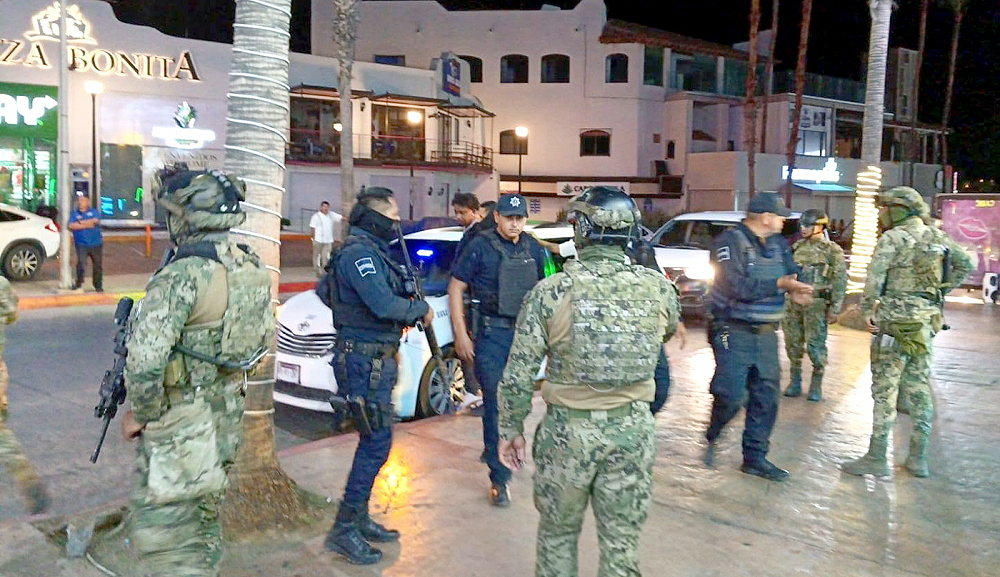
State authorities have emphasized their commitment to maintaining peace throughout Baja California Sur. While focusing resources on Los Cabos, considered a strategic point for criminal organizations, they are also monitoring vulnerable areas such as fishing regions in Comondú, drug distribution routes through Loreto, and ongoing conflicts in Mulegé between rival criminal groups.
Authorities have deployed surveillance resources aimed at locating leaders of different criminal cells and dismantling threats.
“We are working to maintain stability, and as organized crime actors move, we have the capacity to design strategies to contain what must be contained,” said Saúl González.
Recently, residents have reported increased sightings of a drone resembling an MQ-9 Reaper, a military surveillance unmanned aerial vehicle often used for intelligence gathering and target identification.
Meanwhile, surveillance has intensified in northern Baja California Sur, and authorities continue sharing intelligence to reduce violence among factions of the Sinaloa Cartel.
The Secretary General noted that military, naval, National Guard, state investigative agencies, and municipal police forces are working together to monitor attempts by organized crime figures to enter Baja California Sur.
Additionally, Baja California Sur and Baja California have established joint working groups to coordinate security efforts along the border region between Guerrero Negro and Jesús María. The states have signed cooperation agreements involving prosecutors’ offices and public security agencies, allowing coordinated logistical support and information sharing to improve operational efficiency and strengthen regional security.
Source: zetatijuana