Starting in October, the Baja California Sur state judiciary has a specialized court for issuing protection orders, the second of its kind in the country, to help eradicate all forms of violence against women and vulnerable individuals.
At a press conference, it was announced that this court is located within the facilities of the Women’s Justice Center, situated between Luis Donaldo Colosio Avenue and Carabineros Street in the city of La Paz. It operates 24/7, 365 days a year.
A judge, a court clerk, and a police officer are available at the court to address complaints and reports from women and other vulnerable individuals.
These include victims of digital, obstetric, political, gender-based, domestic, economic, patrimonial, psychological, physical, and sexual violence. Protection orders are initially in effect for 60 days but can be extended for up to 30 additional days if the violence continues.
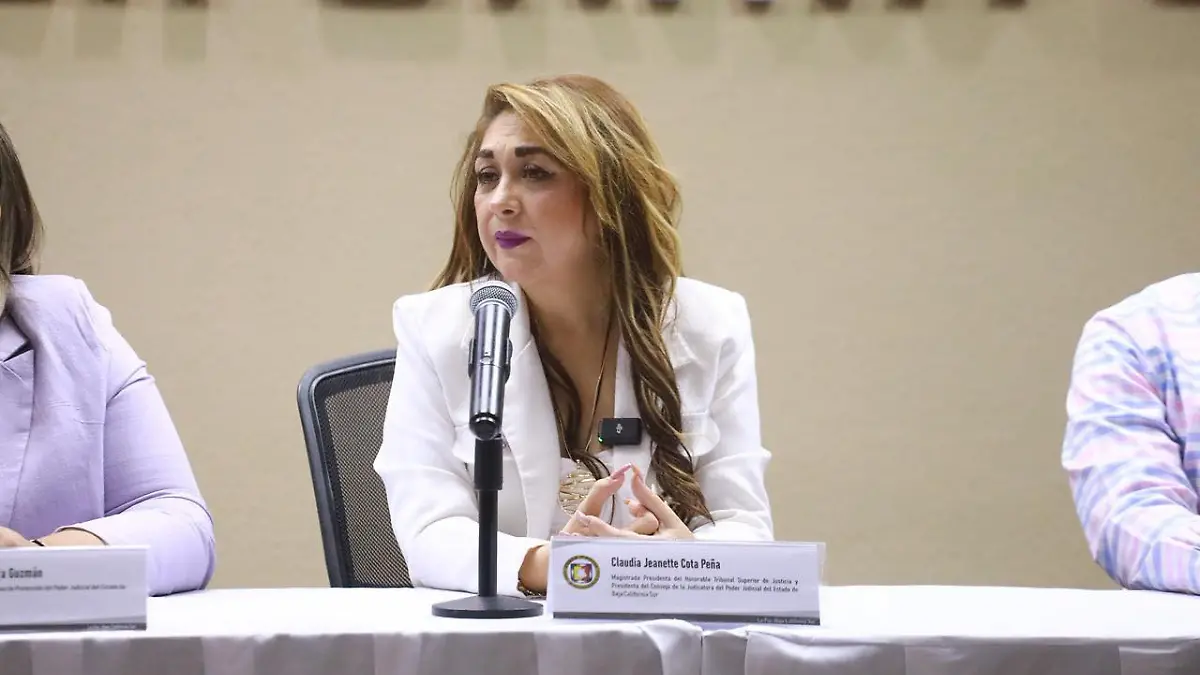
The presiding magistrate of the Superior Court of Justice and the Judicial Council of the state of Baja California Sur, Claudia Cota Peña, explained that this Protection Order Court is a replica of the one created in the state of Oaxaca. It is therefore aimed at women, children, adolescents, people with disabilities, senior citizens, and members of the LGBTQ community who suffer violence in its various forms.
She stated that it is headed by a judge of first instance who can handle complaints related to labor, civil, commercial, family, and criminal matters, as well as many types of violence. The key difference from the Public Prosecutor’s Office is that it is based on the Law on Women’s Access to a Life Free of Violence.
This Law lists the types of administrative protection orders issued by the Public Prosecutor’s Office or the judicial orders that can require the aggressor to leave the home, garnish wages, or provide protective custody for a child or senior citizen, among other measures.
There are many enumerated orders that the judge can issue immediately, and if more are needed, she can do so or even modify them because sometimes it’s unclear whether the person being questioned is telling the truth.
“It’s a court of good faith; we don’t doubt what they tell us, and we don’t need a voter ID to know if the person is truly the victim, because when violence is perpetrated, they might leave their home with nothing, possibly even without shoes.”
She emphasized that it’s a preventative court that seeks to prevent women and other vulnerable people from being abused or even losing their lives. Therefore, the protection provided lasts for 60 days, which can be extended to 90 if necessary.
She explained that since it began operating last month, the court has been a success, and people are already getting used to it and trusting it. When victims of violence call or go to the Women’s Justice Center, the judge attends to them directly; they don’t need to go to the Public Prosecutor’s Office.
However, if a person is at risk of violence and does not have a phone readily available, a system of “purple centers” has been implemented. These are safe zones located in businesses and establishments that are willing to collaborate with the state’s judicial system.
People can go there to ask for help, and the establishment can then connect them with a judge who, in urgent cases, will determine whether to dispatch security personnel.
At the press conference, the keynote address “Justice and Prevalence for a Culture of Peace and the End of Violence Against Women and Girls” was announced. It will be delivered by Dr. Marcela Lagarde, a member of the Academy of Human Rights and the Network Without Borders for the Life and Freedom of Women, among other positions.
Source: oem