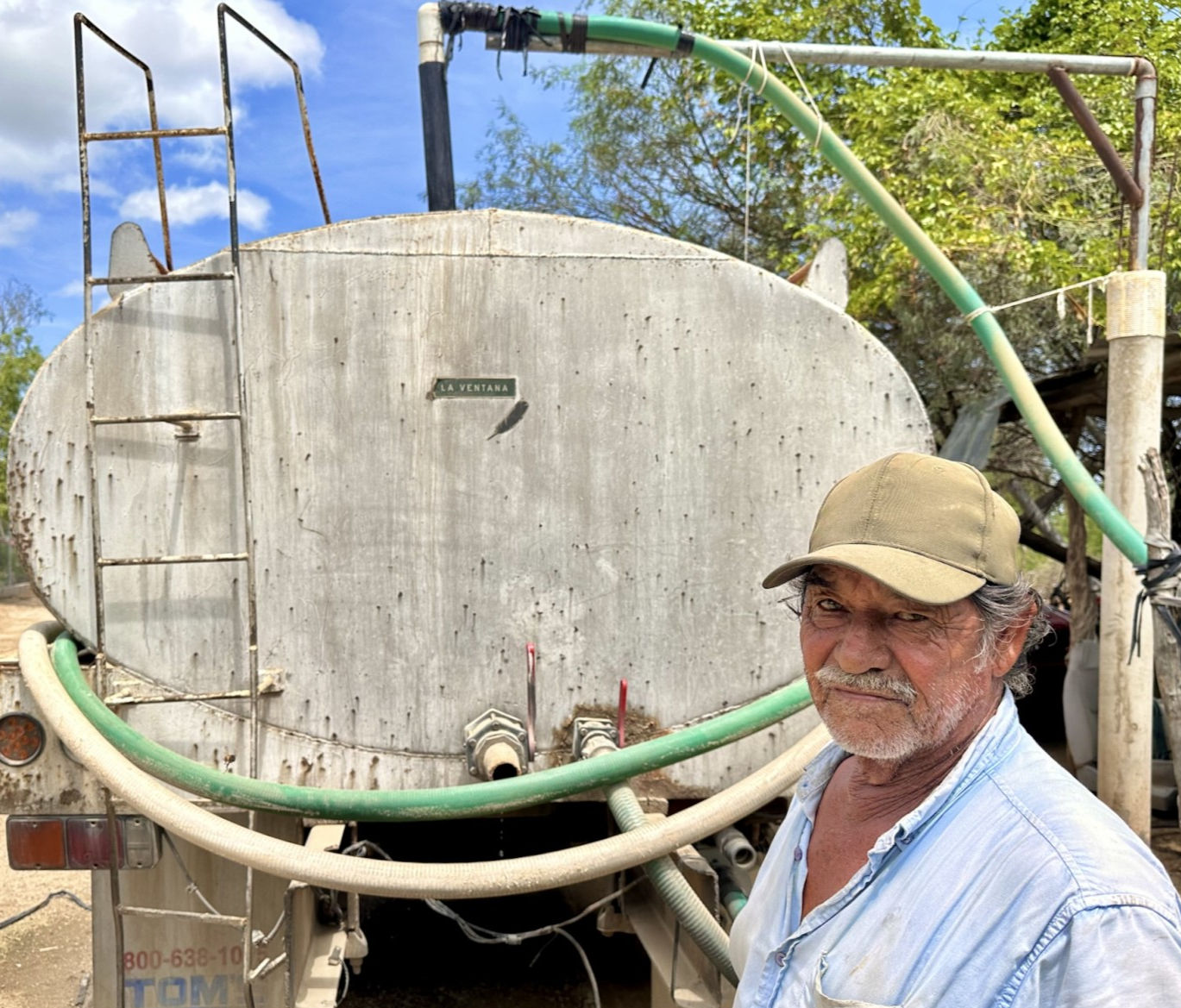

Shortly before 10 a.m. on a Friday, Ramón Rafael Sanders opens another Tecate Light in the cab of his enormous tanker truck. With the empty tank in the back, the truck sits running under the scorching desert sun on the outskirts of La Paz, Baja California Sur, Mexico.
“If there’s no water, there’s no life,” Sanders said in Spanish. “The beer can disappear. The entire ocean can disappear, but not the [drinking] water.”
He estimates that this morning he’ll wait an hour and a half at the private well before it’s his turn to refill the tank in the line of water trucks. In Mexico, “la pipa” is colloquial for a water truck.
In Baja California Sur, the driest state in the country, water trucks are a vital industry and way of life outside of urban centers. In rural areas and small towns, they form the supply chain between wells and water treatment plants, and the countless water tanks in private homes, ranches, and businesses.
Water trucks are also common in some African countries facing water crises, in war-torn Gaza, and in regions of the world where municipal piped water infrastructure is nonexistent, limited, or compromised.
For Sanders—and for any consumer who has to call a water truck every time their home’s water tank runs dry—the distribution model is a daily reminder that water is not an infinite resource. Development is driving the demand for water just as it is becoming increasingly scarce as a result of heat waves, floods, and droughts caused by climate change.
These forces shape the life of Sanders, who at 70 years old runs a water purification and delivery service in his hometown of El Sargento, Baja California Sur.
“With climate change, the planet isn’t being taken care of,” he said. “We don’t know what’s going to happen.”
Hurricanes and tropical storms bring freshwater to the Baja California Peninsula, which stretches 1,220 kilometers (760 miles) into Southern California between the Pacific Ocean and the Gulf of California.
But when seasonal rains fail to arrive or saturate the soil, levels can drop in the aquifers that supply both wells and water trucks.
The pressure from tourism and development in this desert region over the past 20 years is drawing water from some aquifers faster than the natural cycle can replenish them.
This reality of scarcity and demand creates a paradox for Sanders and others in the water industry.
Today, the demand for freshwater means a thriving business. But if demand continues to skyrocket while increasing pressure on the natural water system, at best, the water quality in the aquifer will deteriorate. In the worst-case scenario, the water could run out.
Sanders transitioned from being a commercial fisherman on the ocean to a freshwater provider about 25 years ago. He said one reason for the change was his fear of the ocean after his boat sank, an incident that left him and his son adrift at sea for several days.
Approaching 50, he opened his purified water business, El Mezquite, to serve the twin coastal towns of El Sargento and La Ventana. Both communities are growing rapidly with investment in adventure tourism, vacation properties, and new seasonal homes owned primarily by American and Canadian migrants.
“Water is liquid gold,” Sanders said. “It’s the best business you can find.”
Many of these visitors and residents fill their 20-liter water jugs and campers daily at Sanders’s water purification business, which recently expanded its treatment capacity.
Before selling the drinking water, Sanders runs it through an activated carbon system and filters out salt, other minerals, and any bacteria. This means that worsening well contamination increases his treatment costs.
He estimates he sells 5,000 liters of drinking water per day during peak season.
In addition, he refills the main water tanks of private homes with his 10,000-liter tanker truck. On busy days, he starts at 5 a.m. and makes three trips to refill the well in the nearby town of Los Planes.
The well charges 500 Mexican pesos for every 10,000 liters, which he delivers to private residents for approximately 1,500 pesos, including the full service of filling their cisterns.
Sanders says he remembers that 40 years ago, seasonal rains were more predictable in the hills above El Sargento, with precipitation arriving regularly in early summer.
“It’s changing. Back in my day, it was much better than it is today, mainly because of the rain,” he said.
Records from the past four decades show an average annual rainfall of just 18 centimeters in the municipality of La Paz, which includes El Sargento. But the variations can be dramatic, ranging from as little as 2.7 centimeters of rain one year to as much as 16 times that amount in another. Years with almost no rain bring little or no recharge to the aquifer and underground wells.
In the La Paz region, the late summer of 2025 saw several centimeters of rain. This followed approximately 18 months with almost no rain, making 2024 the driest year of this century in Baja California Sur. Experts fear that consecutive dry spells in the near future could devastate water security.
“The water problem is very complex,” said María Z. Flores López, a hydrologist and director of the Integrated Water Management Program at the Autonomous University of Baja California Sur. “Little rain. Saltwater intrusion. Population growing every year, and tourism.”
In coastal aquifers, a decrease in the freshwater level causes seawater to seep in, a threat exacerbated by rising sea levels. Put another way: as municipal demand on the freshwater aquifer increases, the available water becomes saltier, requiring more filtration and treatment before use.
In light of Baja’s water challenges and the La Paz aquifer operating at a deficit, the federal government is building a new $133 million dam, El Novillo, designed to supply water to 250,000 residents.
After tossing a cold beer to another tanker driver waiting at the well, Sanders shares his vision of our changing planet. Over-extraction of oil, he says, is a serious problem.
“There are a lot of people who care more about money than the land. They’re taking money from the land and they want to get richer and richer,” he said.
He holds up his fingers in a circle, describing the Earth as an egg. Humans are extracting the substance from the center, he said, an action that throws everything around it out of balance.
He first noticed the change with a decline in marine life. Now he sees it in rainfall patterns and the availability of fresh water. Even the sun’s rays are hotter these days, he said—consistent with studies that point to heat and increased evaporation rates as accelerating drought in recent years.
“If a drunk person drinks a lot, how does their vision look when they’re walking? The same thing is happening to the land,” Sanders said.
So far, he says, none of that has slowed his business. It may even be increasing demand for his clean water, for the time being. But he wonders what the future holds for his five children and 12 grandchildren.
“I don’t have much money or anything, but you know what I do have? A very good family. That’s the most important thing,” he said. “And they’re the ones who stay.”

Source: yaleclimateconnections