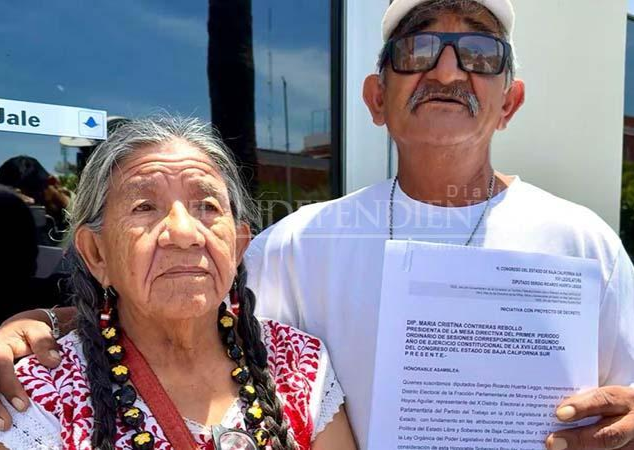

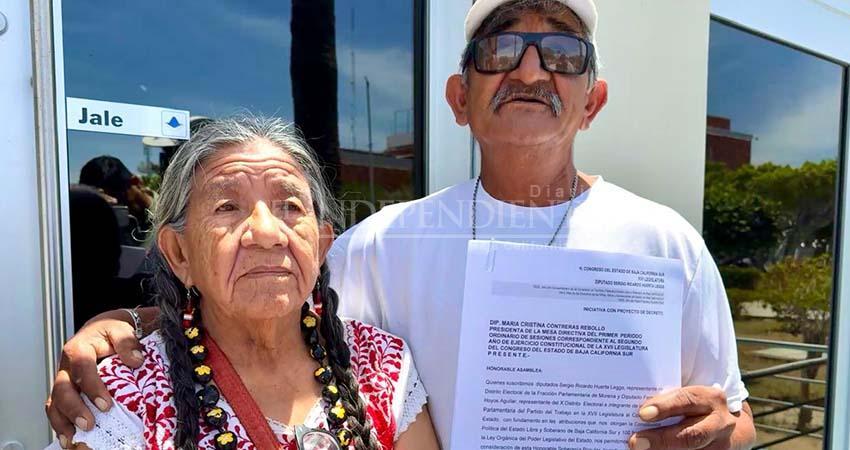
Members of the “Patas Saladas” movement visited the Baja California Sur (BCS) Congress to raise awareness of their struggle for recognition as descendants of the Cochimí people originally from Guerrero Negro, in the municipality of Mulegé.
During a press conference, the attendees presented family trees, lists of signatures, birth certificates, requests for anthropological expert reports, territorial maps, and documentation related to legal processes initiated before the National Institute of Indigenous Peoples (INPI).
The visit took place in the context of a proposed decree to guarantee the indigenous recognition of the Cochimí, Guaycura, and Pericú peoples, which they submitted to local representative Sergio Huerta Leggs.
“Here we are,” stated Juana Villa Poblano, known to members of the movement as “Mamá Tana” and a traditional authority within the group.
The movement members maintain that there is a lack of recognition in Baja California Sur for descendants of the peninsula’s indigenous peoples.
“We want recognition for the Guaycura, Pericú, and Cochimí peoples,” stated Juana Villa Poblano during an interview with Diario El Independiente.
- Documents and Community Structure
According to documents provided by the group, the “Patas Saladas” movement is primarily composed of fishing families settled in Guerrero Negro and other areas of northern Mulegé.
The documents submitted include community records, internal regulations, and a “Council of Elders” made up of individuals identified by the group as traditional representatives.
Among the names included are Juana Villa Poblano, Francisco Castillo Maclish, Ramón Castillo Gómez, María del Rosario Fátima Castillo Camacho, and José Castillo Camacho.
During the interview, Francisco Castillo Maclish was introduced as the president of the Council of Elders.
The documents also list Jesús Alfredo Salgado Villa as one of the movement’s main promoters and facilitator of applications related to community recognition.
The files also include requests addressed to the National Institute of Indigenous Peoples (INPI) for an anthropological assessment related to the presence of Cochimí descendants in Guerrero Negro.
In this petition, members of the movement request documentation of genealogical, territorial, and cultural elements linked to the community.
According to documents provided by the group, the term “Pata Salada” (Salty Foot) is related to historical practices connected to the Ojo de Liebre lagoon complex and fishing activities carried out in the salt-producing region of Guerrero Negro.
The group maintains that their ancestors used salt as part of food preservation and subsistence practices.
In addition to genealogical references, the files contain territorial maps, lists of applicants, and proposals related to spaces designated for fishermen and Cochimí descendants of Guerrero Negro.
They also include official letters sent to state and municipal authorities regarding road access, land regularization, and the rehabilitation of infrastructure historically used by fishermen in the area.
More than 500 descendants, they claim
During the interview, members of the movement stated that they have currently identified at least 36 people directly linked to the initial group of fishermen associated with the movement.
However, they asserted that the family trees compiled by the community encompass more than 500 descendants.
“We are more than 500 across the entire family tree from a common ancestor,” they stated.
The group also maintains that it has participated in initiatives promoted by the National Institute of Indigenous Peoples (INPI) related to the formation of the State Indigenous and Afro-Mexican Council of Baja California Sur.
“They still consider us an extension of the north”
Another point raised by members of the movement concerns Indigenous representation in Baja California Sur.
During the interview, they indicated that they believe decisions related to Indigenous affairs continue to be concentrated outside the state.
“They still consider us an extension of Baja California Norte,” they stated.
Community representatives stated that they seek greater participation in state representative bodies and recognition for Indigenous communities historically linked to Baja California Sur.
“We are Indigenous brothers and sisters, of course we are, but we must give respect and recognition to those who were here before us,” commented one of the participants.
Source: diarioelindependiente